Holdmark And Western Sydney University Turn Parramatta Office Tower Into 600 Student Beds
Parramatta's office-to-housing shift has moved from planning debate to a specific student accommodation deal, with Holdmark Property Group and Western Sydney University announcing a $100 million conversion of 10 Valentine Avenue into purpose-built rooms for up to 600 students.
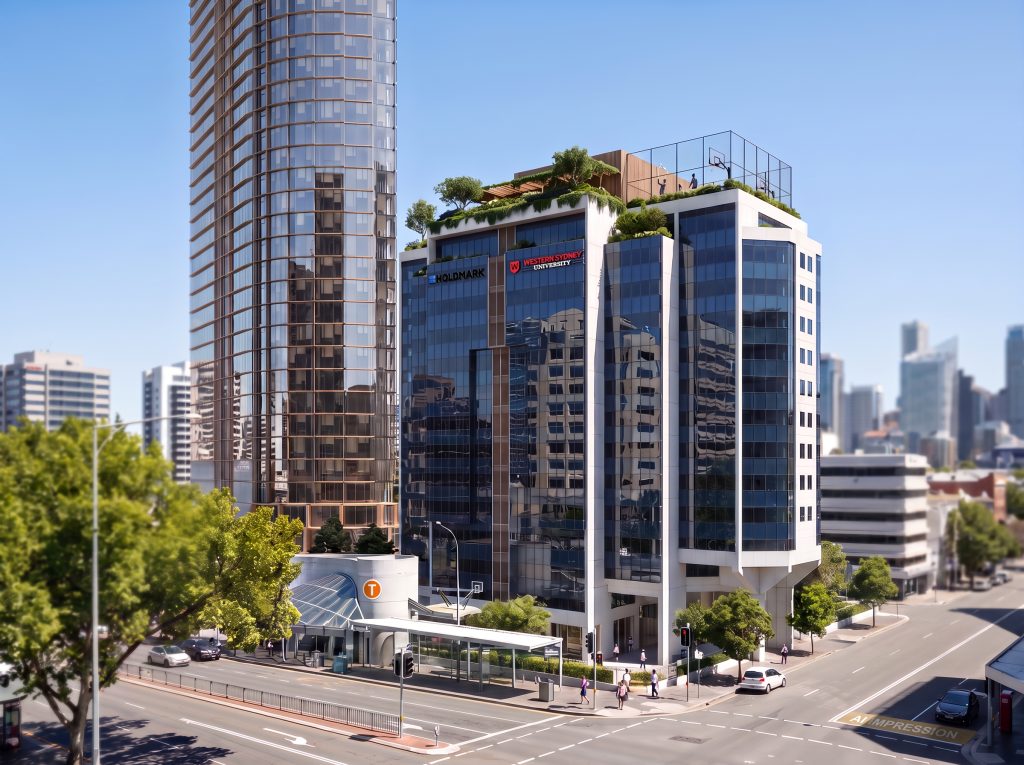
An official project impression shows the 10 Valentine Avenue building beside Parramatta Station that Holdmark and Western Sydney University plan to convert into student accommodation.
Parramatta's office-to-housing shift has moved from planning debate to a specific student accommodation deal, with Holdmark Property Group and Western Sydney University announcing a $100 million conversion of 10 Valentine Avenue into purpose-built rooms for up to 600 students.
The project is a practical Greater Sydney story because it sits directly beside Parramatta's rail and bus interchange, close to Western Sydney University's CBD campuses, and inside a city centre still trying to balance offices, homes, education, hospitality and major public investment. The 30 July media release says the vacant older commercial building will be retained and refurbished rather than demolished, with construction and refurbishment expected to start next month and first student occupation targeted for the fourth quarter of 2027.
The location is the point. Student housing is most useful when it reduces the daily friction of study: long commutes, uncertain private rentals, late-night travel, and the cost of living away from services. Holdmark and Western Sydney University say the building will sit within walking distance of campus, public transport, shops, hospitality and employment opportunities. That could make the accommodation more than a bed count if the final pricing and management model genuinely suit students who are already under rental and transport pressure.
The building also tells a wider Parramatta story. The release says Holdmark acquired the broader 2-10 Valentine Avenue site from Australian Unity in 2024. The existing building was completed in the late 1980s, contains about 16,000 square metres of commercial space across 14 levels, and previously housed NSW Government offices before departments shifted to newer Parramatta Square premises. In other words, this is not a greenfield student village. It is a reuse of office floor space that had lost its previous purpose.
That matters because Parramatta is full of competing growth signals. Sydney Metro West, Powerhouse Parramatta, Parramatta Square, Western Sydney University's CBD presence and private high-rise proposals all point to a bigger centre. But growth can become lopsided if workers, students, residents and visitors do not all have places to be. An empty office building beside the station is not helping street activity. A managed student community could add daily foot traffic, demand for local cafes and services, and a stronger connection between the university and the CBD.
The proposal includes study and breakout areas, gym and yoga facilities, music and jam rooms, rooftop recreation and sporting areas, communal kitchens and social spaces. Those details should be watched closely because student accommodation can either support a proper student life or become a compact rental product with a university label. The amenity list suggests the partners understand that students need space beyond bedrooms, especially if the building is adapting a commercial floorplate rather than starting from a residential design.
Holdmark chief operating officer Kevin Nassif framed the deal as a way to give a vacant building a new purpose while supporting Parramatta's future as an education, employment, culture and innovation centre. Western Sydney University chief operating officer Bill Parasiris said the project would increase dedicated student accommodation supply, help meet demand and reduce pressure on the broader housing market. Those claims are plausible, but the proof will sit in delivery, affordability and occupancy.
For residents, the main local question is whether the project helps Parramatta work better at street level. Hundreds of students near the station could mean more life outside office hours, but also more pressure on footpaths, local shops, waste services and public spaces. If managed well, adaptive reuse can be a cleaner answer than demolition and rebuild, particularly when a building already has the location advantage. If managed poorly, it can become another large private facility that adds population without enough neighbourhood benefit.
The useful conclusion is narrow: 10 Valentine Avenue is now a live test of whether Western Sydney can turn surplus office stock into student housing close to transport. It will not solve Parramatta's housing challenge on its own, but it gives residents a concrete project to watch as the city shifts from a government office centre into a denser education and mixed-use CBD.
From the desk. Sydney and Surrounds is a practical local newsroom for Greater Sydney. If there is something in your suburb that deserves more attention, we would like to hear about it.