John Graham E-Bike Parking Plan Gives Sydney Councils New Footpath Powers
A $6.6 million NSW program will fund marked shared e-bike parking bays and tougher operator controls across 16 Sydney council areas, with new powers to set zones and penalties.
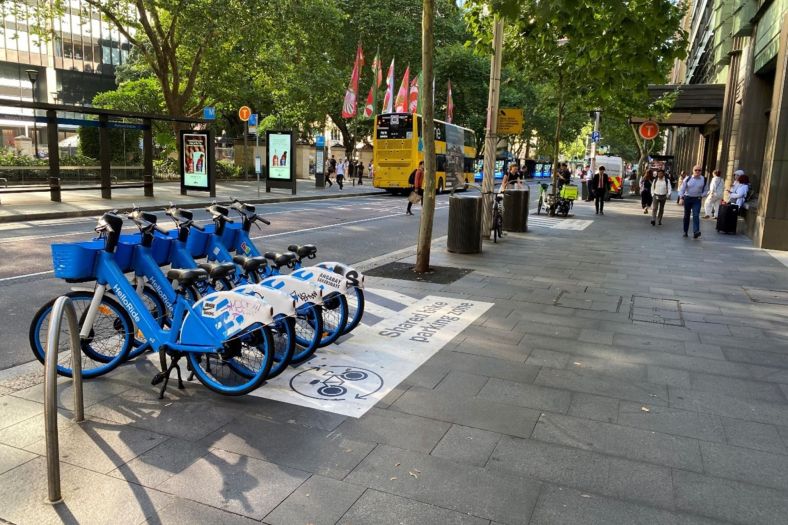
A marked shared e-bike parking bay near a Sydney transport hub, shown in NSW Government pilot material.
Sydney councils are being handed a more direct way to manage shared e-bikes after the NSW Government announced a $6.6 million program to fund marked parking bays and tougher operator controls across the city.
The practical change is that councils and other public authorities will be able to apply for up to $200,000 to deliver e-bike parking and improve rider behaviour. The program is funded by a 60 cent fee on each shared e-bike trip, with Transport for NSW aiming to deliver 250 parking bays for 2,500 shared e-bikes this year. The government says staged new rules will give councils and NSW Government land managers powers to set required parking zones and penalise shared e-bike operators if bikes are not left in the right place.
For residents, the policy is less about transport theory than the condition of the footpath outside a station, shopping strip or apartment block. Shared e-bikes have become a normal part of getting around inner and middle Sydney, but the parking problem has grown with them. A bike left across a narrow path can be an annoyance for one person and a genuine access barrier for someone using a wheelchair, pushing a pram, walking with limited vision or trying to pass with shopping.
The program names 16 council areas hosting shared bike schemes, including the City of Sydney, Inner West, North Sydney, Canterbury-Bankstown, Burwood and Parramatta. That spread matters. The issue is no longer only a CBD problem. It now follows the network of train stations, metro stops, village centres and nightlife strips where short trips make sense. If parking bays are placed only where they are easy to mark rather than where bikes actually pile up, residents will not see much improvement.
The enforcement side is also important. Transport for NSW can revoke an operator's approval for failing to meet minimum standards and issue penalties of up to $55,000 for failure to comply with a removal order, plus $5,500 for each day the offence continues. Councils will also be able to decide no-go and go-slow zones and choose which operators can set up in their area. That gives local authorities more than a complaint inbox. It gives them a way to shape the market.
The government says previous marked-bay trials reduced kicked-over bikes and blocked footpaths by half. That is the figure to watch as the program expands. A bay that is geofenced inside the app can make the end of a ride clearer for the rider and more manageable for the operator. A bay that is badly located, too small or invisible at night may simply move the clutter from one point to another.
Sydney's broader e-bike debate also remains unsettled. The new framework sits beside other safety moves, including reducing the legal power limit, action on illegal high-powered private e-bikes and battery safety standards. Those issues are related but not identical. A properly powered shared e-bike can still be a footpath hazard if it is abandoned across a pedestrian route.
For Greater Sydney, the strongest version of the policy would be practical and local: bays near busy transport hubs, beach approaches, high streets, campuses and nightlife areas; operator data shared with councils; and enough enforcement to make poor parking costly. The weakest version would be a set of painted boxes that riders ignore because the app, the street design and council follow-up do not align.
The next test is delivery. Residents in the affected council areas should see whether parking bays appear in the places where complaints have been strongest, and whether operators update their apps so riders cannot end trips anywhere convenient. If the program works, the shared e-bike can become less of a footpath argument and more of a useful last-kilometre transport option.
From the desk. Sydney and Surrounds is a practical local newsroom for Greater Sydney. If there is something in your suburb that deserves more attention, we would like to hear about it.