Kogarah Golf Club Redevelopment Moves To Response Stage With Cooks River Safeguards In Focus
The proposed redevelopment of the former Kogarah Golf Club site has moved into the response-to-submissions stage, keeping pressure on the project's transport, river and open-space impacts.
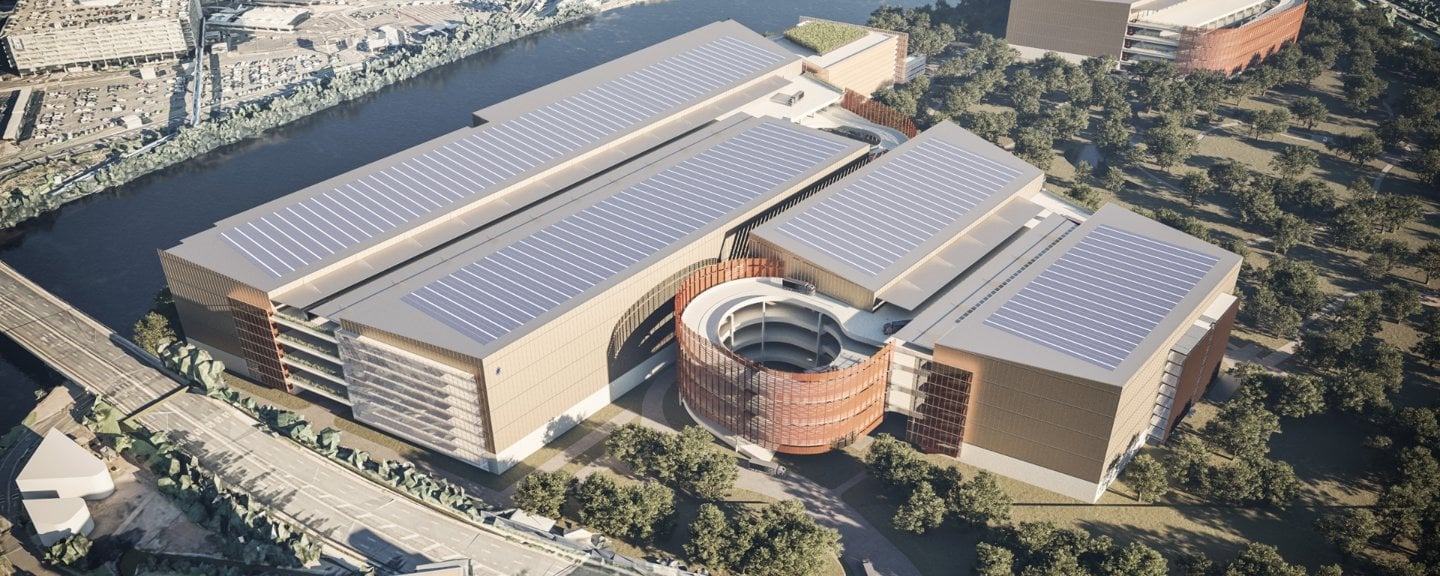
An artist impression of the proposed Kogarah Golf Club redevelopment logistics precinct.
The proposed redevelopment of the former Kogarah Golf Club site has moved into the response-to-submissions stage, keeping pressure on the project's transport, river and open-space impacts. The NSW planning portal lists the proposal as the Kogarah Golf Club redevelopment concept and stage one works, with the current status shown as Response to Submissions. The portal describes a concept proposal and stage one development application for the former golf club site, including five blocks of up to 70 metres for a variety of potential uses and initial site preparation works.
The scale explains the attention. Stockland says the project is being pursued through a 50/50 joint venture with John Boyd Properties after the site was rezoned in May 2025. The proponent describes a potential logistics precinct of up to 340,000 square metres on an 18.3-hectare site, positioned near Sydney Airport, Port Botany and major roads. That location is commercially powerful, but it also sits beside the Cooks River and close to existing communities that will want to know how traffic, building height, flood risk, public access and environmental repair are being handled.
The planning portal now shows hundreds of submissions on the proposal. That does not decide the assessment, but it does show that the project has become a major local planning issue rather than a routine industrial redevelopment. For residents around Arncliffe, Wolli Creek, Kogarah, Rockdale and the lower Cooks River catchment, the questions are likely to be practical: how many trucks will use local roads, what happens to public open space, how the river edge is treated, and whether the benefits of jobs and logistics access outweigh the local burden.
Cooks River Alliance has called for stronger safeguards before any approval is granted. Its public position asks for measures including a developer contribution towards river rehabilitation and management, a minimum 40-metre riparian corridor, a naturalised riverbank, reorientation of Pemulwuy Park towards the riverfront, and early delivery of public access and open space. The alliance also raised climate resilience and community engagement concerns, arguing that the river corridor should not be treated as an afterthought to the employment land.
Those safeguards go to the centre of the planning trade-off. A large logistics precinct beside airport and port infrastructure can reduce freight distance and support last-mile distribution. At the same time, logistics uses bring vehicle movements, hardstand areas, building mass and stormwater issues that require careful design when they meet a river system already under pressure. The Cooks River has long been the subject of rehabilitation work across multiple councils and community groups, so the question is not whether the site is valuable, but what public and environmental conditions should attach to such a valuable redevelopment opportunity.
The response-to-submissions stage is where the proponent is expected to answer issues raised during exhibition and by agencies. For the public, it is a useful moment to watch for design changes, additional traffic analysis, environmental commitments and any proposed conditions that would bind the developer rather than simply noting concerns. It is also where the difference between a concept image and an assessed development becomes clearer.
For Sydney and surrounding suburbs, the Kogarah proposal is a live example of a wider pattern: industrial and logistics demand is pushing closer to established communities as online shopping, airport freight and port connections reshape land values. Whether this project proceeds, changes substantially or faces stronger conditions, the assessment will signal how NSW planning balances employment land with river repair, public access and neighbourhood impact on one of southern Sydney's most watched redevelopment sites.
From the desk. Sydney and Surrounds is a practical local newsroom for Greater Sydney. If there is something in your suburb that deserves more attention, we would like to hear about it.