Anthony Gabrielian Green Knott Profile Puts Sydney Food Waste Start-Up Into Urban Circular Economy Focus
Sydney founder Anthony Gabrielian is using black soldier fly larvae to upcycle food waste into reusable protein, putting a local start-up at the centre of urban circular-economy thinking.
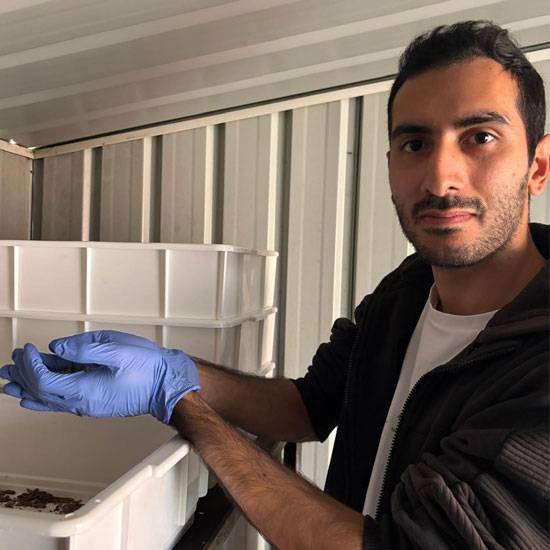
Green Knott founder Anthony Gabrielian handling black soldier fly larvae in a food waste recycling facility.
Sydney-based Green Knott has given today's pack its founder-focused local business story, with a published profile of founder Anthony Gabrielian and the company's work using black soldier fly larvae to turn food waste into reusable protein. The profile, published on 22 June, describes Green Knott as a Sydney-based agritech company tackling the food-waste problem by upcycling organic scraps. It also places Gabrielian's founder journey in the practical world of operations, technology, connectivity and urban circular-economy design rather than the usual startup language of pitch decks and valuations.
The scale of the problem is large enough to justify local attention. Federal environment figures cited in the profile say Australia produces 7.6 million tonnes of food waste each year, costing the economy more than $36.6 billion annually. For Sydney, the issue is visible in apartment bins, cafes, supermarkets, restaurants, food-service sites, offices and household kitchens. The waste stream is not only an environmental story. It is a logistics, cost, odour, contamination and local-government story that affects how dense suburbs manage daily life.
Green Knott's model uses black soldier fly larvae to consume organic scraps and convert them into protein-rich biomass that can be processed for uses including livestock, aquaculture and pet food. The idea is simple in outline but demanding in practice. Food waste has to be collected, sorted, processed and managed in controlled conditions. The insect system has to be reliable, hygienic and commercially useful. Customers need confidence that waste is being handled properly and that the output has a real market rather than becoming another disposal problem.
Gabrielian said his inspiration came from seeing an overseas example of insects breaking down organic waste and recognising that discarded materials could have a better use than landfill. He also discussed work on a compact insect-farming system for apartment buildings and other urban environments. That detail makes the story especially relevant to Greater Sydney. A city with more apartment living cannot rely only on suburban backyards, individual compost bins or distant processing sites. Dense housing needs systems that can fit closer to where waste is produced without creating nuisance for residents.
The founder angle matters because waste innovation is rarely glamorous. It is a business built around things people would rather not think about: scraps, contamination, smell, collection timing, maintenance, regulation and repetitive operations. A founder in this space needs more than a clever sustainability claim. They need the patience to prove that the system works when customers are busy, buildings are constrained and margins are tight. The profile presents Green Knott as a company still refining ideas rather than pretending the whole challenge is solved.
There is also a local-business lesson in the way Green Knott sits between environment policy and everyday operations. Governments can set food-waste targets and encourage landfill reduction, but businesses and buildings need workable tools. A cafe owner, strata manager or food-service operator will not adopt a system because it sounds worthy. They need it to be simple, cost-aware, clean and compatible with existing routines. Start-ups that solve those operational details can make sustainability feel less like a campaign and more like infrastructure.
The next question for Sydney is whether urban circular-economy systems can move from niche pilots into repeatable local services. If Green Knott's compact approach works in apartment or high-density settings, it could help reduce the distance between waste generation and waste recovery. If it remains difficult to operate at scale, the profile still shows where the city's waste challenge is heading: toward smaller, smarter systems that try to turn local scraps into useful inputs.
For Sydney and Surrounds, Gabrielian's story fits the founder rule because it is not only about a person starting a company. It is about a local operator trying to solve a daily Sydney problem in a practical way. The strongest founder stories are often like this: less polished, more operational, and connected to the unglamorous systems that determine whether a big city becomes easier or harder to live in.
From the desk. Sydney and Surrounds is a practical local newsroom for Greater Sydney. If there is something in your suburb that deserves more attention, we would like to hear about it.