Domain Forecast Puts Sydney House Prices On Track For The Biggest Capital-City Fall
Domain forecasts Sydney house prices could fall between 3 and 7 per cent in the coming financial year, wiping up to $122,000 from a typical home and making Sydney one of the weakest capital-city markets.
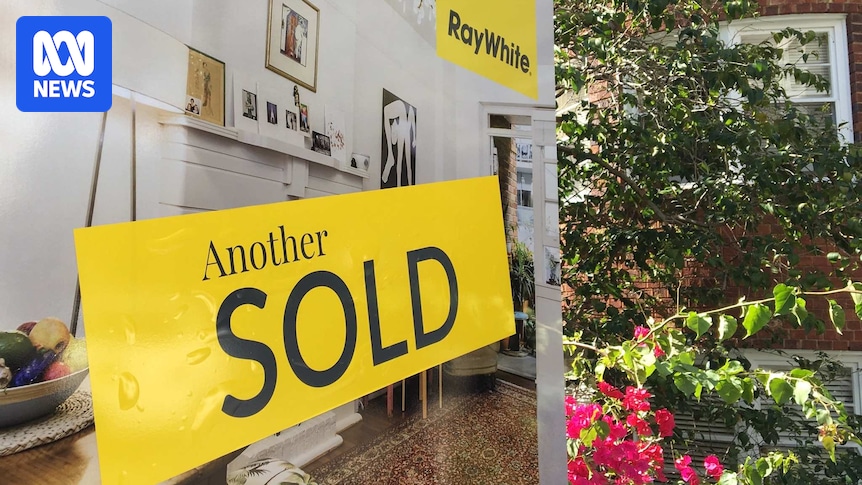
A sold sign used in ABC News coverage of Domain forecasts for Sydney and Melbourne house prices.
Sydney homeowners, buyers and renters have a new property-market test to watch after Domain forecast Sydney house prices could fall by between 3 and 7 per cent over the next financial year. ABC News reported on 25 June that the forecast would make Sydney one of the weakest capital-city house markets in the country, with the upper end of the range equal to as much as $122,000 being wiped from the value of a typical Sydney house.
The forecast matters for Sydney and its surrounding suburbs because it cuts through the usual property-market shorthand. A falling headline price does not automatically mean housing is suddenly affordable. It can mean borrowing capacity has been squeezed, sellers are holding back, buyers are nervous, and first-home buyers are forced to compromise on location, dwelling type or family plans. Domain's forecast sits in exactly that mix: higher interest rates, a changing tax-policy environment, weaker auction conditions and affordability limits that are pushing many buyers toward units.
ABC reported that Domain expects unit prices to outperform houses in the coming financial year, particularly where first-home buyer schemes and affordability constraints make apartments the only realistic entry point. That has a clear Greater Sydney reading. In suburbs near rail, metro, universities, hospitals and town centres, units can become the pressure valve when detached houses move out of reach. In outer suburbs, the same shift can leave buyers weighing a larger home and longer commute against a smaller dwelling with better transport access.
The forecast also needs to be read beside the Cotality resale data cited by ABC. Cotality found 96 per cent of residential resales in the March quarter made a nominal profit, with the median gain rising to a record $377,000. That means many established owners are still selling with large paper gains built up over years of price growth. The pressure is sharper for recent buyers who entered near the peak, took on larger mortgages and have had less time to build equity before interest-rate rises hit household budgets.
For local readers, the useful question is not whether one forecast is perfectly right. It is which households are exposed if the direction proves right. Recent buyers in high-price suburbs may have less room to move. Upgraders may delay selling if they cannot get the price they expect. Investors may reassess returns if borrowing costs rise and tax rules change. Renters may still face tight vacancy conditions even if house prices cool, because a cheaper headline sale price does not create more rental supply by itself.
The geographic detail is also important. ABC reported that Cotality's postcode-level data showed many of the steepest January-to-May dwelling-value falls were in Greater Sydney and Melbourne, including Sydney's east and the northern beaches. That does not mean every suburb is moving together. Sydney's market is fragmented by school zones, transport links, land size, apartment supply, local incomes and the number of owners willing to sell.
For Sydney and Surrounds, the forecast should be treated as a practical watchlist for the second half of 2026. Auction clearance rates, days on market, vendor discounting, mortgage arrears, investor listings and unit-price resilience will show whether Sydney is moving through a soft patch or a more serious correction. The city has spent years treating rising prices as normal. A cooler market may help some buyers, but it will also test the households and suburbs most stretched by the last cycle.
From the desk. Sydney and Surrounds is a practical local newsroom for Greater Sydney. If there is something in your suburb that deserves more attention, we would like to hear about it.